Panda Learn Chinese

Loading

Archives 2016

чэнъюй, идиома, идиоматическое выражение, фразеологизм

Basic Rules of Hanyu Pinyin – Set Phrases (chéngyǔ)

  1. Four-character Set Phrases that can be divided into two halves are linked by a hyphen. For example:
    • céngchū-bùqióng (happens/ed endlessly),层出不穷
    • guāngmíng-lěiluò (be righteous) 光明磊落
  2. All other four-character set phrases and well-known expressions (shúyǔ) that cannot be readily segmented are linked. For example:
    • bùyìlèhū (Isn’t it a happy thing?)不亦乐乎
    • àimònéngzhù (Sorry that I can’t help you).爱莫能助

Basic Rules of Hanyu Pinyin – Function Words (xūcí) are separated from other words

  1. Adverbs:
    • hěn hǎo (be good/fine), 很好
    • zuì dà (be the biggest), 最大
    • fēicháng kuài (be extremely fast) 非常快
  2. Prepositions:
    • zài qiánmiàn (in the front), 在前面
    • shēng yú 1940 nian (was born in 1940) 生于一九四零年
  3. Conjunctions:
    • nǐ hé wǒ (you and I); 你和我
    • Nǐ lái háishi bù lái? (Are you coming [or not]?) 你来还是不来?
  4. The Constructive Auxiliaries (jiégòu zhùcí) de/d (的 ), de/di (地 ), de (得), zhi (之).
    • mài cài d(e) (vegetable seller[s]), 卖菜的
    • mànmàn de/di zou (walk slowly), 慢慢的
    • hóng de hěn (be really hot) 红得很
  5. The Model Auxiliary is written separately at the end of a sentence:
    • Nǐ zhīdào ma? (Do/Did you know)? 你知道吗?
    • Kuài qù ba! (Hurry and go!) 快去吧
  6. Exclamation:
    • A, zhēn měi! (Ah, It’s really beautiful!) 啊,真美!
  7. Onomatopoeia:
    • Pā! (Bang!”); 啪
    • Hōnglōng yi sheng (a rumbling sound) 轰隆一声

Basic Rules of Hanyu Pinyin – Numerals and measure words

  1. Whole numbers from eleven to ninety-nine are written together
    • shíwǔ (fifteen), 十五
    • sānshísān (thirty-three) 


    十一
    二十一
    三十一
    四十一
    五十一

    èr
    sān


    liù


    jiǔ
    shí
    shí yī
    èr shí yī
    sān shí yī
    sì shí yī
    wǔ shí yī
    один

    два
    три
    четыре
    5
    шесть
    семь
    восемь
    девять
    десять
    одиннадцать
    Двадцать один
    Тридцать один
    Сорок один
    Пятьдесят один

    one
    two
    three
    four
    Fives
    six
    Seven
    Eight
    nine
    ten
    eleven
    twenty one
    thirty-one
    forty one
    fifty one
  2. Bǎi (hundred), qiān (thousand), wàn (ten thousand), (hundred million) are linked with the integer in front of them, but “ten thousand” and “hundred million” are separated from zeros following them. For example:
    • jiǔyì líng qīwàn èrqiān sānbǎi wǔshíliù (900,072,356) 九亿七万两千三百五十六
  3. Di + Numeral indicates order, and it is linked by a hyphen with the number. For example:
    • dì-shísān (thirteenth),第十三
    • dì-èrshíbā (twenty-eighth)第二十八
  4. Numbers and Measure Words are separated:
    • liǎng ge rén (two people), 两个人
    • yī dà wǎn fàn (a big bowl of cooked rice)一大碗饭

    Duō, lái, jǐ” indicate a rough quantity (yuēshù), and they are separated from the numbers and measure words that precede and follow them. For example:

    • yībǎi duō ge (more than 100), 一百多个
    • shí lái wàn rén (about 100,000 people)十来万人

    Numbers indicating “more than ten and several score” are linked. For example:

    • shíjǐ ge rén (more than ten people),十几个人
    • jǐshí ge rén (several tens of people)几十个人

Basic Rules of Hanyu Pinyin – Pronouns

  1. Men indicates the plural and is linked with the noun in front of it. For example:
    • wǒmen (we/us), 我们
    • tāmen (they/them) 他们
  2. Demonstrative pronouns zhè, nà and the interrogative demonstrative pronoun are separated from the nouns that follow them.
    • zhè (ge) rén (this person), 这个人
    • zhè zhī chuán (this boat), 这只船
    • nǎ zhāng bàozhǐ (which newspaper?) 哪张报纸?

    zhè, nà, nǎ are linked with xiē, me, yàng, bān, lǐ, biān, huǐr, ge

    • zhèxiē (these), 这些
    • zhège (this one), 这个
    • nàyàng (that way/then), 那样
    • zhèhuǐr (at this moment) 这会儿
  3. Gè, měi, mǒu, běn, gāi, wǒ, nǐ, and so forth are separated from the nouns or measure words that follow them. For example:
    • gè guó (each country), 各国
    • gè gè (each, every), 各个
    • měi nián (every year), 每年
    • gāi gōngsī (this/that company) 该公司

Basic Rules of Hanyu Pinyin – Adjectives

  1. Monosyllabic adjectives link with their reduplicated prefixes or suffixes. For example:
    • mēngmēngliàng (dimly bright),
    • liàngtāngtāng (brightly lit)
  2. Adjectives are separated from xiē, yīxiē, diǎnr, yīdiǎn that follow them. For example:
    • kuài (yī)xiē ([be] faster),
    • kuài (yī)diǎn ([be] faster)

Basic Rules of Hanyu Pinyin – Verbs

  1. (Monosyllabic) action verbs are linked with the suffixes zhe, le, guo. For example:
    • kànzhe (reading/looking),
    • kànle (read [once at a past moment/time]),
    • kànguò (have/had read [at least once])

    Le at the end of a sentence is separated from the sentence. For example:

    • Huǒchē dào le (Completed action: The train came/has come).
  2. Action Verbs and their Objects are separated. For example:
    • kàn xìn (read a letter),
    • chī yú (eat fish),
    • kāi wánxiào (make a joke)

    But the action verb and object are linked when they together express one concept. For example:

    • chīfàn (eat/make a living),
    • shuìjiào (sleep),
    • kànshū (read),
    • dǎqiú (play [ball game]),
    • jūgōng (bow),
    • kētóu (kowtow)

    The syllables of Verb+Object type compound words are written separately when another element is inserted between the syllables. For example:

    • jūgōng (bow) à jūle yī ge gōng (bowed once)
  3. An Action Verb and its complement are linked if both are monosyllabic. Otherwise they are separated. For example:
    • gǎohuài (ruin it),
    • zǒu jìnlái (walk in),
    • xiūlǐ hǎo (fix/repair [and make] it [mended])

Basic Rules of Hanyu Pinyin – Nouns

  1. Monosyllabic prefixes and suffixes are linked with nouns. Prefixes: fù- (vice), zǒng- (general/main/chief), fēi- (non), fǎn-[anti], chāo- (super/surpass), lǎo – (old/venerable), A – (marker of a nickname/endearment), (-ble), wú- (non), and so forth. Suffixes: -zǐ, -ér, -tóu (head, nominal ending), -xìng(nature), -zhě/yuán (-ist), -jiā (expert/-ist), -shǒu(hand/person/expert/-ist), -huà (-ized), men (-s/es), and so forth). For example:
    • fù-bùzhǎng (vice-director of a [government] department),
    • zǒng-gōngchéngshī (chief engineer),
    • yìshùjiā (artist [in general]).
  2. Nouns and the directional words/locations after them are separated.
    • mén wài (outside the door)=mén wàimian(/wàibiān/wàitou),
    • huǒchē shàngmian (on the train)

    The syllables of lexical items are linked.

    • hǎiwài (this means “overseas,” not “outside of the sea”)
  3. Surnames and given names (xìngmíng/míngzi) are written separately in the Chinese Han language. The first letters of surnames and the given names are capitalized. Pen names (bǐmíng) and nicknames (biémíng) are written according to the same principles:
    • Wáng Jiànguó,
    • Dōngfāng Shuò,
    • Zhāng Sān

    A personal name and the person’s professional title are separated:

    • Wáng bùzhǎng,
    • Lǐ xiānsheng/xs

    The first letter of personal addresses such as Lǎo, Xiǎo, Dà, Ā, and so forth are capitalized. For example:

    • Xiǎo Liú (Little Liu),
    • Wú Lǎo (honorable Old Wu),
    • Sān (The Third [in a family])

    When the surname of historically well-known figures is combined with a respectful or descriptive term by which they are commonly known, the syllables are linked, and the first letter is capitalized. For example:

    • Kǒngzǐ (Confucius),
    • Bāogōng (Grand Judge Bao),
    • Xīshī (Beauty Xishi)
  4. Proper names and general names of places are separated and the first letter of each of the names is capitalized.
    • Běijīng Shì (Beijing City),
    • Dòngtíng Hú (Lake Dongting)

    The monosyllabic prefixes or suffixes of proper names and general names are linked. For examples:

    • Jǐngshān Hòujiē (Back Street of Jingshan),
    • Cháoyángménnèi Nánxiǎojiē (Southern Small Street Inside the Gate Facing the Sun)

    Link the syllables of established names for villages, towns, and other places when it is not necessary to distinguish whether they are proper names or general names (the first letter is capitalized). For example:

    • Wángcūn (Wang Village),
    • Zhōukǒudiàn (a place near Beijing where the fossilized remains of Peking Man were discovered),
    • Sāntányìnyuè (Moon Reflected in Three Ponds)
  5. Personal and place names not in the Chinese Han language, based on the principle of “according with the custom of the person in question (míng cóng zhǔrén),” are written either in the original language or transcribed in Roman letters. For example:
    • Einstein (Ài’īnsītǎn),
    • Ngapoi Ngawang Jigme (Āpèi Āwàng Jìnměi),
    • London (Lúndūn),
    • Washington (Huáshèngdùn)

    Foreign names transcribed in the Chinese Han language are written according to the pronunciation of the corresponding characters. For example:

    • Nánměi (South America),
    • Déguó (Germany),
    • Dōngnányà (Southeast Asia)

Basic Rules of Hanyu Pinyin – General rules

  1. Words are the basic units for spelling the Chinese Common Language.
    • rén (person/people),
    • péngyou (friend[s]),
    • túshūguǎn (library/libraries)
  2. Structures of two or three syllables that indicate a complete concept are linked:
    • quánguó (the whole nation),
    • duìbuqǐ (sorry),
    • qiūhǎitáng (begonia)
  3. Separate terms with more than 4 syllables if they can be separated into words, otherwise link all the syllables:
    • wúfèng gāngbǐ (seamless pen),
    • yánjiūshēngyuàn (graduate school),
    • jīngtǐguǎn gōnglǜ fàngdàqì (transistor power amplifier),
    • Hóngshízìhuì (Red Cross)
  4. Reduplicated monosyllabic words are linked, but reduplicated disyllabic words are separated:
    • rénrén (everybody),
    • chángshi chángshi (give it a try)

    Juxtaposed reduplications (AABB structures) are separated by a hyphen:

    • láilái-wǎngwǎng (come to and fro)
    • qīngqīng-chǔchǔ (be clearly)
  5. In certain situations, for the purpose of making it convenient to read and understand the words, a hyphen can be added:
    • huán-bǎo (environmental protection)
    • shíqī-bā suì (17 or 18 years old)
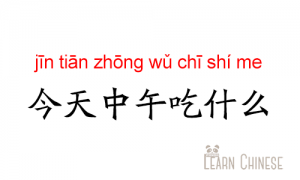
What we will eat in lunch? in Chinese

What we will eat in our lunch?

What we will eat in lunch? in Chinese jīn tiān zhōng wǔ chī shí me

今天中午吃什么

What we will eat in our lunch?

lǎo hǔ :hǎo è ,jīn tiān zhōng wǔ wǒ men chī shí me ?

老虎:好饿,今天中午我们吃什么?

xióng māo :wǒ zhǔ le yì dà lì miàn

熊猫:我煮了意大利面。

lǎo hǔ :shì fān qié wèi de ma ?

老虎:是番茄味的吗?

xióng māo :bù shì ,shì xiāng cài wèi dào de ,nǐ kě yǐ chī xiāng cài ma ?

熊猫:不是,是香菜味道的,你可以吃香菜吗?

lǎo hǔ :wǒ kě yǐ chī xiāng cài 。

老虎:我可以吃香菜。

xióng māo :tài hǎo lā !

熊猫:太好啦!

Pasta in Chinese

Tiger: So hungry, what I can eat?

Panda: I cooked pasta.

Tiger: tomato flavor is it?

Panda: No, coriander flavor, you can eat parsley do?

Tiger: I can eat parsley.

Panda: great!
 

Combinations of initials and finals

These are the syllables of Mandarin Chinese as shown in the combinations of initial and final sounds and as spelled in Hanyu Pinyin.

  b p m f d t n l g k h z c s zh ch sh r j q x
a ba pa ma fa da ta na la ga ka ha za ca sa zha cha sha a
o bo po mo fo o
e me de te ne le ge ke he ze ce se zhe che she re e
ai bai pai mai dai tai nai lai gai kai hai zai cai sai zhai chai shai ai
ei bei pei mei fei dei tei nei lei gei kei hei zei zhei shei ei
ao bao pao mao dao tao nao lao gao kao hao zao cao sao zhao chao shao rao ao
ou pou mou fou dou tou nou lou gou kou hou zou cou sou zhou chou shou rou ou
an ban pan man fan dan tan nan lan gan kan han zan can san zhan chan shan ran an
ang bang pang mang fang dang tang nang lang gang kang hang zang cang sang zhang chang shang rang ang
en ben pen men fen den nen gen ken hen zen cen sen zhen chen shen ren en
eng beng peng meng feng deng teng neng leng geng keng heng zeng ceng seng zheng cheng sheng reng eng
ong dong tong nong long gong kong hong zong cong song zhong chong rong
u bu pu mu fu du tu nu lu gu ku hu zu cu su zhu chu shu ru wu *
ua gua kua hua zhua chua shua rua wa *
uo duo tuo nuo luo guo kuo huo zuo cuo suo zhuo chuo shuo ruo wo *
uai guai kuai huai zhuai chuai shuai wai *
ui dui tui gui kui hui zui cui sui zhui chui shui rui wei * 1
uan duan tuan nuan luan guan kuan huan zuan cuan suan zhuan chuan shuan ruan wan *
uang guang kuang huang zhuang chuang shuang wang *
un dun tun nun lun gun kun hun zun cun sun zhun chun shun run wen * 2
ueng weng *
i bi pi mi di ti ni li zi † ci † si † zhi ‡ chi ‡ shi ‡ ri ‡ ji qi xi yi +
ia dia lia jia qia xia ya +
ie bie pie mie die tie nie lie jie qie xie ye +
iao biao piao miao diao tiao niao liao jiao qiao xiao yao +
iu miu diu niu liu jiu qiu xiu you + 3
ian bian pian mian dian tian nian lian jian qian xian yan +
iang niang liang jiang qiang xiang yang +
in bin pin min nin lin jin qin xin yin +
ing bing ping ming ding ting ning ling jing qing xing ying +
iong jiong qiong xiong yong +
ü ju ※ qu ※ xu ※ yu ※
üe nüe lüe jue ※ que ※ xue ※ yue ※
üan juan ※ quan ※ xuan ※ yuan ※
ün jun ※ qun ※ xun ※ yun ※

Notes:

  • Represents a zero initial (i.e. where nothing comes before the final sound in the far left column)
  • * Whenever u comes at the beginning of a syllable, it is written w. W, however, must not appear without an additional vowel, so u as a complete syllable is not written as w by itself but as wu.
  • The i in zi, ci, si is different from most other uses of i in that it is short, not long. It is represented in IPA by ɿ .
  • The i in zhi, chi, shi, ri is different from most other uses of i in that it is short, not long. It is represented in IPA by ʅ .
  • + Whenever i comes at the beginning of a syllable, it is written y. Thus, Y, however, must not appear without an additional vowel, so not y, yn, yng but yi,yin, ying.
  • Hanyu Pinyin simplifies the spellings of syllables with ü by using the u form instead in cases where no ambiguity could result. This is merely a spelling convention; the u‘s here are still pronounced ü.
  • 1 wei: ui is actually an abbreviation of uei. This is why Hanyu Pinyin uses, for example, shui, not shuei, and dui, not duei.
  • 2 wen: un is actually an abbreviation of uen.
  • 3 you: iu is acutally an abbreviation of iou. Thus, since i is written y at the beginning of a syllable, the spelling becomes you instead of yu (which would be not only misleading but wrong).
  • er has been omitted from this table.

 From – http://www.pinyin.info/

Verified by MonsterInsights